Bishop’s Palace · Governor’s Castle
Narcissus and GoldmundThe Bishop’s Palace / Governor’s Castle is the contested center of authority in the bishop’s city: during the bishop’s flight amid plague and disorder, Count Heinrich governs from the castle as the Emperor’s agent. Its corridors and private rooms bring political negotiation into intimate contact with Goldmund’s affair with Agnes; after their meeting, the same household space becomes the route to his imprisonment and threatened execution. Narcissus’s intervention there saves Goldmund, but the pardon is secured through concessions to the count, making the castle a setting where law, clerical authority, and political power intersect.
Political Setting and Rule
The castle’s political importance follows a period of upheaval. During the plague, a mob burned a hospital and pillaged several wealthy burghers’ houses; after the bishop fled, the city lacked order and security. The Emperor sent Count Heinrich, a favored courtier entrusted with imperial business, to restore control with a small force of horsemen and soldiers. His rule brought hardships for the citizens, and the city council had grown weary of dealing with him in place of the bishop, whose return was expected.
The count’s authority was not merely local. When Goldmund later asks why Narcissus is at the governor’s palace, Narcissus explains that he has come as one of the religious order’s delegates to negotiate with the count, an imperial representative, over matters requiring settlement between the Emperor and the order. The talks have achieved little. The castle is therefore both a residence of government and a venue for negotiations between secular and religious institutions, although the balance of power is unequal: Narcissus’s eventual success in saving Goldmund requires concessions to the count.
Agnes’s Rooms and Goldmund’s Arrest
Goldmund comes to the castle carrying a gold chain and is admitted only after insisting that it be delivered to Agnes or her chambermaid. A servant leads him through the busy courtyard and into the corridors, where he waits for a long time. He is finally guided into a small room crowded with dresses, coats, hats, and boots. After waiting there, he meets Agnes, who has come from the count’s company with a brief interval in which she believes they are safe. She welcomes him, and they share a first kiss before going into her bright, candlelit bedchamber, where a meal has been set out. Their meeting is both clandestine and precarious: it takes place inside the count’s household, under the authority of the man whose mistress Agnes is.
The danger arrives when a nearby door slams and footsteps approach. Agnes recognizes the count’s approach and pushes Goldmund into the closet room, urgently telling him to escape without betraying her. Goldmund finds the corridor door locked from the outside and realizes he may have been trapped. Rather than expose Agnes, he decides not to betray her. When the count enters with a candlestick and unsheathed sword, Goldmund takes dresses and coats into his arms, hoping to be mistaken for a thief and so find a way out.
The count treats the apparent theft as sufficient grounds for punishment. He asks whether Goldmund has molested Agnes, then dismisses the need to investigate further because Goldmund is to be hanged for theft. He orders the guards to bind the homeless vagrant, put him in the dungeon, and hang him the following morning. Three armed footmen take Goldmund through the corridors and down into the cellar. The sequence turns the castle’s private rooms into an improvised court of power: the count decides the charge and sentence, while Goldmund’s actual meeting with Agnes remains hidden behind the accusation.
The Dungeon and the Right to Confession
Before Goldmund is led into the cellar, two priests returning from the castle chapel stop to ask whether the condemned man has a confessor. On learning that he has just been arrested, one of them insists that Goldmund must receive confession and the holy sacraments before execution. The priest requires the guards to swear that Goldmund will not be taken away before he has spoken with him, and says he will address the count that evening. The men do not dare contradict a church dignitary who is among the count’s guests.
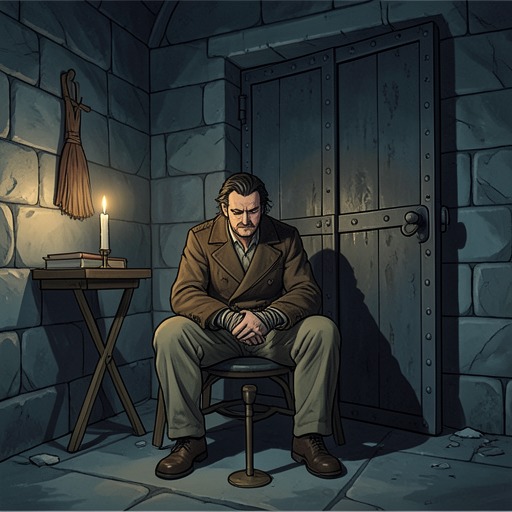
Goldmund is then taken through a heavy cellar door into an anteroom of the wine cellar, furnished with a table and three-legged stools. The guards tell him a priest will come to hear his confession and lock the door behind him. The scene places a procedural religious claim inside the count’s stronghold: although the count has ordered an immediate execution, clerical authority secures Goldmund time for confession and the sacraments. The intervention does not itself cancel the sentence, but it makes the prospect of execution subject to a competing institutional obligation.
Pardon and Political Bargaining
Narcissus reaches Goldmund at the castle after the arrest and tells him that he has been pardoned. Now Abbot, Narcissus has come both to announce the reprieve and to take his friend away from the city. Goldmund responds with brittle, playful composure, but the two hold each other’s hands for a long time, their reunion charged by the fact that Goldmund had expected to be hanged within the hour. The rescue is not simply an act of friendship carried out beyond politics: Narcissus has been in the palace as a delegate negotiating with Count Heinrich.
After they leave, Goldmund asks about his arrest. He acknowledges that the scene made him look like a thief, then explains that he had been meeting the count’s mistress and is surprised that the count released him at all. Narcissus answers that the count was not above bargaining. Goldmund does not know that, on the previous night, Narcissus secured his life by paying for it with concessions to the count. The castle thus links the personal and the political in a sharp reversal: the encounter that appears to end in a straightforward criminal sentence becomes an occasion for negotiation, and Goldmund’s freedom carries a cost to the religious order.
Narrative Significance
The castle concentrates the book’s competing forms of authority into one place. The count can command guards, define Goldmund as a thief, and announce a hanging; the priests can insist on a condemned prisoner’s religious rights; Narcissus can negotiate a pardon because he represents an institution with political standing. None of these powers is absolute. The count’s sentence is checked first by the demand for sacramental access and then by a bargain, while the church’s success in saving Goldmund comes at a political price.
Its movement from public courtyard to private chamber, locked closet, corridor, and cellar gives the episode its tightening structure. Goldmund enters seeking Agnes and is drawn through spaces controlled by the count; a locked door converts a hiding place into a trap, and the cellar makes the threatened execution physically immediate. Yet the castle is also where Narcissus restores the friendship and carries Goldmund away. It is therefore not only the setting of danger but the site where private desire, legal vulnerability, religious procedure, and political compromise meet.